





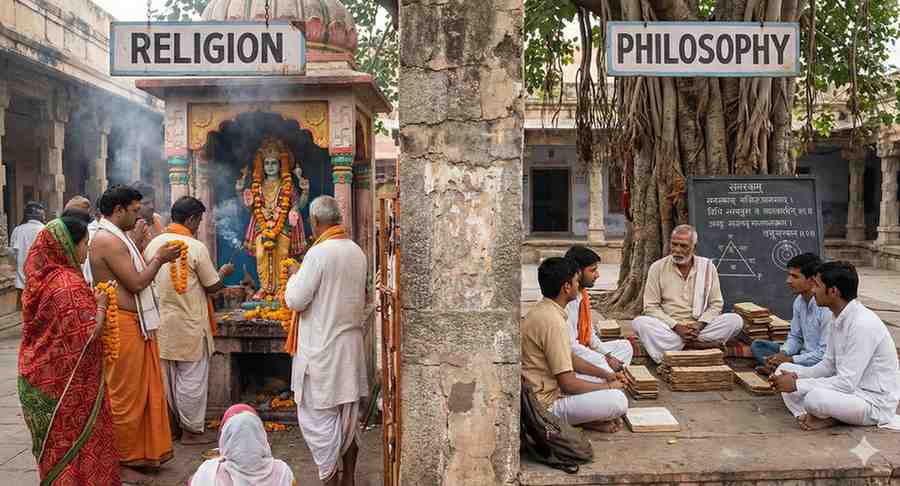
Hinduism, often described as a way of life rather than a religion, seamlessly intertwines religion and philosophy. Its scriptures, practices, and traditions encompass both devotion and introspection, making it difficult to draw a clear boundary between the two. Yet, as the modern world continues to categorize religion and philosophy as distinct disciplines, the question arises: Can we separate religion
Hinduism, often described as a way of life rather than a religion, seamlessly intertwines religion and philosophy. Its scriptures, practices, and traditions encompass both devotion and introspection, making it difficult to draw a clear boundary between the two. Yet, as the modern world continues to categorize religion and philosophy as distinct disciplines, the question arises: Can we separate religion from philosophy in Hinduism?
This article delves into the interplay between religious practices and philosophical inquiry in Hinduism, exploring their shared goals and unique distinctions.
The Religious Aspect of Hinduism
Hinduism’s religious framework is deeply rooted in faith, rituals, and devotion, offering individuals a structured approach to spirituality.
Key Features of Religion in Hinduism
- Rituals and Worship: Practices like puja, yajnas, and pilgrimages foster a direct connection with the divine.
- Deities and Symbolism: Polytheism in Hinduism allows for devotion to various deities like Vishnu, Shiva, and Durga, each representing unique cosmic forces.
- Sacred Texts: Texts like the Vedas, Puranas, and Bhagavad Gita provide guidelines for moral and spiritual conduct.
- Community and Faith: Festivals such as Diwali and Holi reinforce communal bonds and shared spiritual values.
Religion in Hinduism provides a communal and emotional framework for experiencing and expressing devotion.
The Philosophical Dimension of Hinduism
In contrast to its religious practices, Hinduism’s philosophical traditions emphasize reason, inquiry, and the search for universal truths.
Key Features of Philosophy in Hinduism
- Metaphysical Exploration: Philosophical texts, particularly the Upanishads, address questions about existence, consciousness, and liberation (Moksha).
- Schools of Thought: Six classical schools, including Vedanta, Samkhya, and Nyaya, offer systematic inquiries into the nature of reality and ethics.
- Universal Principles: Concepts like Brahman (ultimate reality) and Atman (individual soul) form the cornerstone of Hindu philosophy.
- Personal Inquiry: Unlike communal rituals, philosophy encourages individual reflection and intellectual growth.
Hindu philosophy invites followers to question and analyze rather than accept truths solely based on faith.
Religion vs. Philosophy: A Comparative Table
| Aspect | Religion | Philosophy |
| Foundation | Based on faith, rituals, and devotion. | Rooted in reason, introspection, and inquiry. |
| Objective | Connecting with the divine and fulfilling Dharma. | Understanding universal truths and achieving Moksha. |
| Approach | Focuses on community practices and shared faith. | Emphasizes individual exploration and reasoning. |
| Primary Texts | Vedas, Puranas, Bhagavad Gita. | Upanishads, Darshanas, Brahma Sutras. |
| Nature | Faith-based and devotional. | Inquiry-driven and analytical. |
Interplay Between Religion and Philosophy
In Hinduism, religion and philosophy are deeply interconnected:
- Shared Textual Foundation: While the Vedas guide rituals, their latter portions, the Upanishads, delve into metaphysical inquiry, seamlessly blending faith with reason.
- Rituals with Philosophical Roots: Practices like mantra chanting and meditation have philosophical underpinnings, symbolizing cosmic truths.
- Philosophical Context for Religious Practices: Concepts like Karma Yoga (path of action) and Bhakti Yoga(path of devotion) in the Bhagavad Gita demonstrate how philosophy enriches religious devotion.
Can They Be Separated?
While religion and philosophy in Hinduism have distinct roles, they cannot be entirely separated:
- Religion without Philosophy: Rituals lose their deeper meaning without the philosophical insights that explain their significance.
- Philosophy without Religion: Abstract concepts risk becoming inaccessible without practical application through faith and rituals.
Modern Relevance
In today’s world, the interplay of religion and philosophy in Hinduism offers valuable lessons:
- Personal Growth: Philosophical reflection helps individuals understand the spiritual essence of religious practices.
- Inclusivity: The integration of faith and reason accommodates diverse spiritual paths, making Hinduism accessible to both the devout and the intellectual.
- Ethical Living: Philosophical concepts like Dharma and Karma guide ethical behavior, while religious rituals reinforce these principles in daily life.
Conclusion: Two Sides of the Same Coin
In Hinduism, religion and philosophy are not opposing forces but complementary dimensions of the same tradition. Religion provides the emotional and communal framework, while philosophy offers intellectual depth and universal insights. Together, they create a holistic approach to spirituality that nurtures both the heart and the mind.
Rather than separating the two, Hinduism teaches us to embrace their synergy, allowing for a spiritual journey that is both meaningful and profound. This harmony between faith and reason continues to make Hinduism a timeless and relevant tradition in the modern world.





















Leave a Comment
Your email address will not be published. Required fields are marked with *