





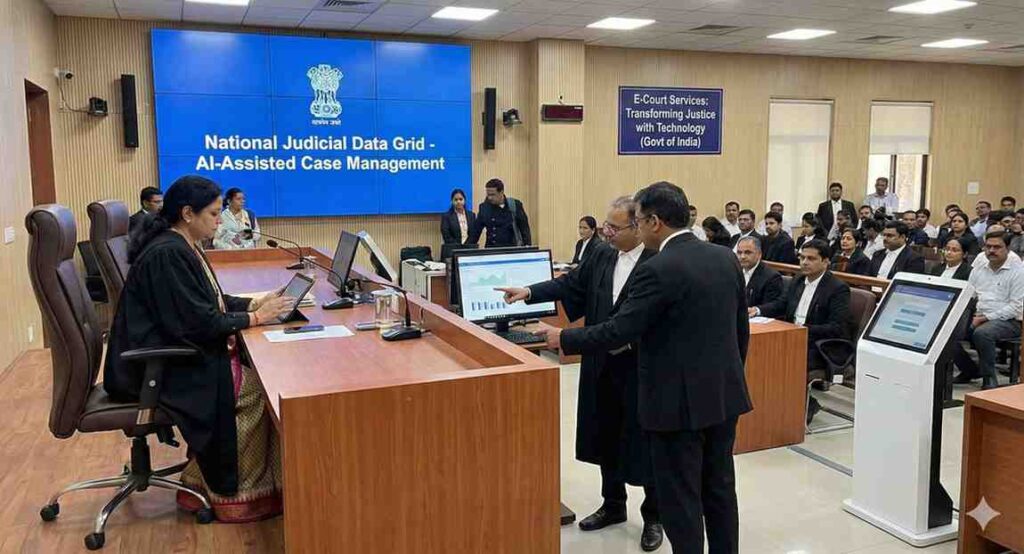
Unveiling how artificial intelligence is transforming India’s judicial system, facilitated by government initiatives aimed at enhancing efficiency, transparency, and access to justice. Key Highlights 1. E-Courts Mission Mode Project As part of the ongoing efforts to modernize India’s judicial system, the E-Courts Mission Mode Project leverages AI technologies to enhance the administration of justice. This
Unveiling how artificial intelligence is transforming India’s judicial system, facilitated by government initiatives aimed at enhancing efficiency, transparency, and access to justice.
Key Highlights
- E-Courts Mission Mode Project: Integration of AI to streamline court procedures and case management.
- AI-Driven Document Analysis: Use of AI to assist in legal document analysis and case preparation.
- Virtual Hearing Facilitation: Implementation of AI technologies to conduct virtual court hearings more effectively.
- Predictive Justice Systems: Experimentation with AI to predict case outcomes and assist judicial decision-making.
1. E-Courts Mission Mode Project
As part of the ongoing efforts to modernize India’s judicial system, the E-Courts Mission Mode Project leverages AI technologies to enhance the administration of justice. This initiative focuses on digitalizing court records and processes, employing AI to manage and analyze vast amounts of data efficiently. This shift not only speeds up case processing but also makes judicial proceedings more accessible to the public.
Implementation Highlights:
- Automated case management systems that use AI to schedule hearings, manage case backlogs, and notify involved parties of updates, thereby reducing delays and improving case throughput.
2. AI-Driven Document Analysis
The complexity and volume of legal documents in the judiciary are significant challenges. AI tools are being deployed to analyze and organize these documents, helping legal professionals and judges prepare for cases more efficiently. AI can extract relevant information, summarize case files, and even suggest legal precedents that may impact the outcome of cases.
Technological Applications:
- Introduction of AI software that scans and indexes thousands of documents daily, providing quick access to necessary legal precedents and related case laws.
3. Virtual Hearing Facilitation
In response to the COVID-19 pandemic, the judiciary has increasingly relied on virtual hearings to continue legal proceedings. AI has played a crucial role in enhancing the quality and effectiveness of these hearings, ensuring that justice delivery remains uninterrupted. AI technologies help in managing video conferencing tools, improving audio-visual quality, and even transcribing proceedings in real-time.
System Enhancements:
- AI-powered systems that optimize bandwidth and audio-visual feeds during virtual hearings, ensuring clear communication regardless of internet speed variations.
4. Predictive Justice Systems
Exploratory projects are underway to evaluate the feasibility of using AI for predictive justice. These systems analyze historical data to predict possible outcomes of cases, which can help judges make more informed decisions. While still in early stages, this application of AI could revolutionize how judgments are prepared and delivered.
Pilot Programs:
- Trial runs of AI algorithms designed to predict verdicts based on case specifics, historical outcomes, and legal statutes.
Challenges and Opportunities
While AI offers promising enhancements to the judicial system, it also poses challenges such as ethical concerns, potential biases in AI algorithms, and the privacy of sensitive data. The judiciary must address these challenges by setting stringent guidelines for AI use, conducting regular audits of AI systems, and ensuring transparency in AI-driven processes.
Conclusion
The Indian government’s initiatives to integrate AI into the judiciary are transforming traditional legal systems into more efficient, transparent, and accessible frameworks. These innovations not only improve the pace at which justice is delivered but also promise to enhance the overall quality of judicial decision-making. As these technologies continue to develop, their thoughtful and ethical implementation will be key to realizing their full potential in advancing the rule of law.





















Leave a Comment
Your email address will not be published. Required fields are marked with *