





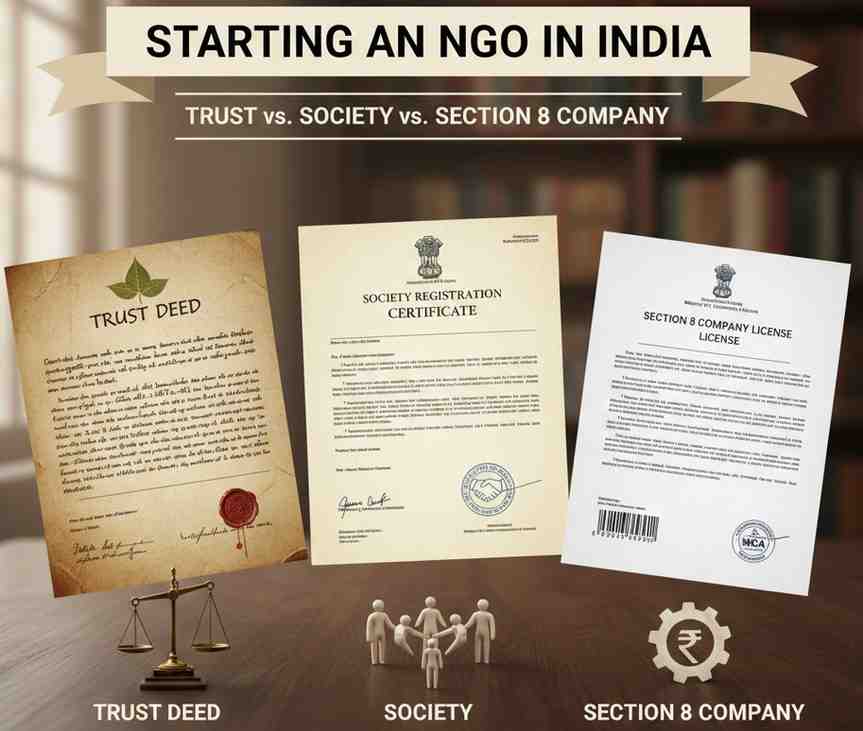
Key highlights First decision: What kind of NGO are you building? Be honest about your endgame: There’s no “best.” There’s only “best for your funding + governance reality.” Option 1: Trust (good for focused control, varies by state) What it is: a legal arrangement managed by trustees, typically created via a trust deed. The Indian Trusts
Key highlights
- “NGO” is a public label; legally you usually choose Trust, Society, or Section 8 Company as the structure. India Code+2India Code+2
- If you want donation credibility at scale, the compliance stack matters: PAN, bank account, governance, Income Tax registrations (12AB/80G), and often NGO Darpan for government-grant ecosystems. Income Tax India+1
- If foreign donations are in the plan, you must think early about FCRA pathways and compliance posture (even if you apply later). fcraonline.nic.in+2fcraonline.nic.in+2
First decision: What kind of NGO are you building?
Be honest about your endgame:
- Local charitable work, small donor base, faster setup → Trust (often)
- Membership-based activity, community org, associations → Society
- Institutional fundraising, CSR tie-ups, tighter governance, high credibility → Section 8 Company
There’s no “best.” There’s only “best for your funding + governance reality.”
Option 1: Trust (good for focused control, varies by state)
What it is: a legal arrangement managed by trustees, typically created via a trust deed. The Indian Trusts Act is primarily for private trusts, and it explicitly does not apply to public or charitable endowments in the same way—public charitable trusts are often governed by state-specific laws/practices. India Code
Setup (practical flow):
- Draft trust deed (objects, trustees, powers, bank operation rules, dissolution)
- Execute deed + register as per local state process (state-specific)
- Apply for PAN + open bank account
- Build basic governance: resolutions, minutes, expense policy
Best for: single-city operations where founders want direct trustee control.
Option 2: Society (good for membership + democratic governance)
Societies are governed through the Societies Registration Act framework (and state adaptations). India Code+1
Setup (typical flow):
- Memorandum of Association + Rules/Regulations (objects, member rules, elections, quorum)
- Register with Registrar of Societies (state process)
- PAN + bank
- Annual compliance: managing body list, minutes, filings (state rules vary)
Best for: associations, alumni bodies, federations, multi-member collectives.
Option 3: Section 8 Company (best governance optics, heavier compliance)
A Section 8 company is a company incorporated for charitable objects with profits applied to objects (not distributed as dividends), under Section 8 of the Companies Act. India Code+1
Setup (realistic flow):
- Decide: company limited by shares or guarantee
- Draft MoA/AoA with Section 8 compliant objects + non-distribution clauses
- Incorporate through MCA process (form-driven, digital signatures, DIN/DSC, etc.)
- PAN/TAN + bank + governance system
Best for: CSR partnerships, institutional donors, grant ecosystems where governance scrutiny is high.
The compliance stack (the part that decides survival)
No matter which structure you choose, serious NGOs usually need:
1) Income Tax registrations for exemption + donor deduction
- 12AB registration is the gateway for claiming exemption for eligible charitable entities, with application handled via prescribed forms (Form 10A/10AB, etc.) and compliance checks on genuineness and other-law compliance. Income Tax India+1
- 80G approval (where applicable) is what makes many donors comfortable because it enables deduction benefits subject to law.
(Do this only when your governance and books are clean. If your accounting is chaotic, you are inviting notices.)
2) NGO Darpan (for government-facing identity)
NGO Darpan is the official portal used in many government grant ecosystems; it issues a unique ID tied to your NGO profile. ngodarpan.gov.in+1
3) FCRA (only if foreign contributions are planned)
FCRA services are run through the Ministry of Home Affairs’ official online portal, with specific forms for registration/prior permission and detailed instructions. Ministry of Home Affairs+3fcraonline.nic.in+3fcraonline.nic.in+3
“Choose your structure” quick questions
If I want CSR funds, which structure is easiest to trust?
In practice, Section 8 often signals stronger governance to corporate compliance teams, but your audits and governance discipline matter more than the label.
Can I start as a Trust and later convert to Section 8?
Restructuring is possible but not “one-click.” Plan for your 3-year horizon before you register.
Do I need NGO Darpan to receive donations?
Not for regular donations—but for many government grant workflows it becomes relevant. ngodarpan.gov.in+1










Leave a Comment
Your email address will not be published. Required fields are marked with *