
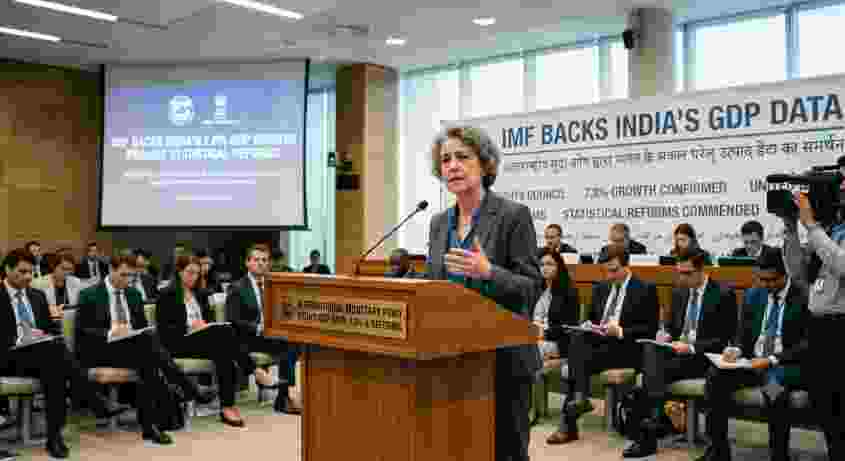
New Delhi, September 2026 — The International Monetary Fund (IMF) has officially ended the debate over India’s economic numbers, firmly backing the country’s newly released 7.8% GDP growth data for the first quarter. What critics called a manipulation of numbers, the global financial watchdog has praised as a long-overdue modernization of India’s statistical framework. Decoding
New Delhi, September 2026 — The International Monetary Fund (IMF) has officially ended the debate over India’s economic numbers, firmly backing the country’s newly released 7.8% GDP growth data for the first quarter. What critics called a manipulation of numbers, the global financial watchdog has praised as a long-overdue modernization of India’s statistical framework.
Decoding the GDP Controversy For weeks, India’s 7.8% growth figure was caught in a political and economic crossfire. The controversy ignited when critics, notably former Finance Secretary Subhash Chandra Garg, questioned the government’s decision to revise historical GDP estimates. The argument suggested that the numbers were artificially inflated. However, leading economists quickly dismissed these claims, pointing out the fatal flaw in the critics’ math: comparing old baseline estimates with revised methodologies is an “apples to oranges” comparison.
The Base Year Switch: Reality, Not Manipulation At the heart of the debate is the shifting of the GDP base year from 2011-12 to 2022-23. Over the last decade, the Indian economy has transformed drastically. The explosive growth of digital payments, e-commerce, and the formalization of markets simply did not exist at the same scale in 2011. Calculating today’s economic output using outdated weights—like assigning too much value to agriculture while ignoring the boom in digital services—would yield entirely inaccurate results. Updating the base year was a mathematical necessity to reflect the modern economy.
The IMF’s Stamp of Approval: IIP and PPI Stepping into the fray, IMF Director of Communications Julie Kozack explicitly welcomed India’s statistical reforms. The IMF highlighted two major upgrades that guarantee the credibility of the new GDP estimates:
- New Index of Industrial Production (IIP): A highly accurate tracking of actual output across manufacturing, mining, and electricity.
- New Producer Price Index (PPI): A refined look at the true costs borne by producers, factoring in raw material price shifts and margins, rather than just looking at end-consumer prices.
By improving these foundational data points, the IMF confirmed that the quality of India’s GDP estimates has structurally improved.
Resilience Amidst Global Shocks The IMF’s praise went beyond just the math. Clocking in at 7.8%, India’s real GDP growth comfortably surpassed the IMF’s own broader expectations. While the world grapples with geopolitical conflicts and volatile oil prices, India absorbed these shocks seamlessly. A strong foreign exchange reserve, a manageable current account deficit, and robust service exports acted as an effective shield against global economic headwinds.
Bottom Line The debate over India’s 7.8% GDP growth was never really about manipulated math—it was about adjusting the lens to view a modernized, digitized economy. With the IMF validating the statistical overhaul, the “data manipulation” narrative has been firmly put to rest. The numbers are not just credible; they reveal an economy growing with remarkable resilience on the global stage.











Leave a Comment
Your email address will not be published. Required fields are marked with *