
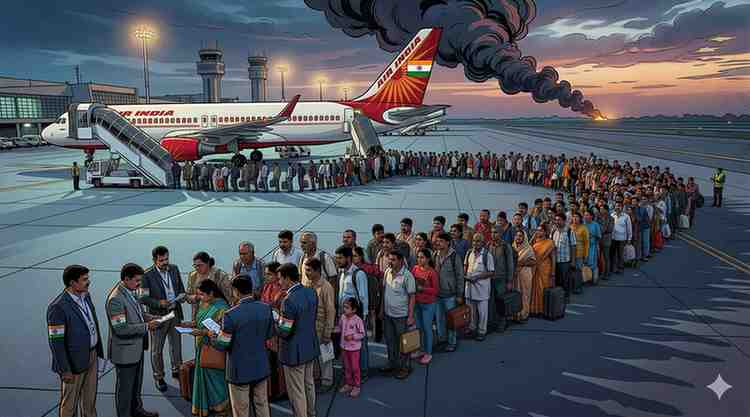
India has activated emergency evacuation protocols to airlift over 1,200 Indian nationals stranded in Iran and neighbouring conflict zones following intensified military exchanges in West Asia. The Ministry of External Affairs confirmed that Operation Suraksha Setu will deploy IAF aircraft and chartered flights over the next 72 hours as diplomatic channels work to secure safe
India has activated emergency evacuation protocols to airlift over 1,200 Indian nationals stranded in Iran and neighbouring conflict zones following intensified military exchanges in West Asia. The Ministry of External Affairs confirmed that Operation Suraksha Setu will deploy IAF aircraft and chartered flights over the next 72 hours as diplomatic channels work to secure safe passage corridors.
New Delhi, April 2026 — The Indian government announced a coordinated multi-ministry response to the escalating West Asia crisis on Thursday, deploying military assets and activating diplomatic back-channels to protect an estimated 8.5 million Indian nationals living and working across the Gulf region.
Why Has India Launched Emergency Measures Now?
The inter-ministerial committee convened after fresh airstrikes disrupted commercial aviation routes across the Persian Gulf, leaving hundreds of Indian workers stranded at airports in Tehran, Bandar Abbas, and Shiraz. Foreign Secretary Vikram Misri confirmed that three Air India Express flights were diverted mid-route on Wednesday. The Ministry of Civil Aviation has since issued a NOTAM restricting Indian carriers from Iranian and Iraqi airspace until further notice. India’s swift response reflects lessons learned from the 2015 Yemen evacuation, when Operation Raahat successfully rescued over 4,600 Indians.
What Is at Stake for India’s Energy Security?
India imports approximately 15 percent of its crude oil from Gulf nations, with shipments transiting the Strait of Hormuz facing unprecedented insurance premium hikes. Petroleum Minister Hardeep Singh Puri assured Parliament that strategic petroleum reserves can sustain 90 days of demand. However, economists warn that prolonged disruption could push inflation above the RBI’s comfort zone. The government is reportedly accelerating talks with Russia and Guyana to diversify import sources.
- Over 1,200 Indians being evacuated from Iran in first phase
- 8.5 million Indian nationals reside across the Gulf region
- Strategic petroleum reserves cover 90 days of consumption
- Air India, IAF C-17 aircraft deployed for Operation Suraksha Setu
- MEA helplines receiving 3,000+ calls daily from anxious families
How Are Other Ministries Responding?
The Defence Ministry has placed the Western Naval Command on heightened alert, with INS Vikrant and escort vessels positioned in the Arabian Sea. The Home Ministry issued advisories to state governments with large Gulf-returnee populations, including Kerala, Tamil Nadu, and Uttar Pradesh, to prepare reception centres. The Finance Ministry confirmed that remittance flows, worth $32 billion annually from the Gulf, remain unaffected thus far but monitoring systems have been activated.
What Happens Next?
Diplomatic sources indicate that External Affairs Minister S. Jaishankar will travel to Doha this weekend for emergency consultations with Qatari and Omani counterparts who are mediating between warring parties. India’s permanent representative to the UN has called for an emergency Security Council session. If hostilities persist beyond two weeks, analysts predict fuel price revisions domestically and potential disruption to infrastructure projects employing Indian workers across the UAE and Saudi Arabia. The government has urged citizens to register with Indian missions and avoid non-essential travel to the region until stability returns.












Leave a Comment
Your email address will not be published. Required fields are marked with *