
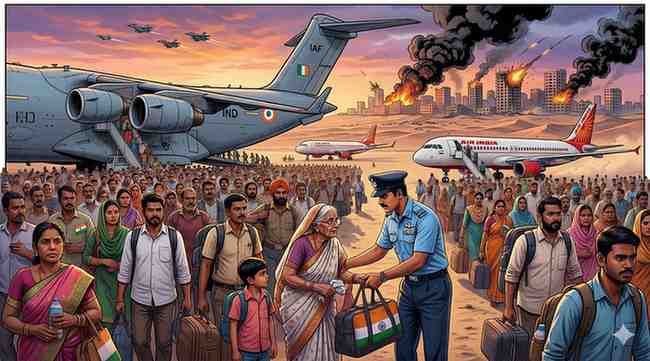
India has launched a coordinated emergency response involving multiple ministries to protect nearly 9 million Indian nationals in West Asia amid escalating regional hostilities. The government has activated contingency evacuation plans and established 24/7 crisis helplines while negotiating safe passage corridors with neighbouring nations. New Delhi, April 2026 — The Ministry of External Affairs, in
India has launched a coordinated emergency response involving multiple ministries to protect nearly 9 million Indian nationals in West Asia amid escalating regional hostilities. The government has activated contingency evacuation plans and established 24/7 crisis helplines while negotiating safe passage corridors with neighbouring nations.
New Delhi, April 2026 — The Ministry of External Affairs, in coordination with Defence and Civil Aviation ministries, has placed all Indian missions across the Gulf on high alert following a sharp deterioration in the West Asia security situation, with contingency plans now operational for what could become India’s largest-ever evacuation exercise.
Why Has India Escalated Its Emergency Response?
The Gulf region hosts approximately 8.9 million Indian workers, primarily in the UAE, Saudi Arabia, Kuwait, Qatar, Oman, and Bahrain, representing the world’s largest diaspora concentration in a single region. Recent military exchanges between regional powers have disrupted commercial aviation routes and raised fears of wider conflict spillover. India’s 2015 Yemen evacuation, Operation Raahat, extracted 4,640 Indians and 960 foreign nationals — the current scenario potentially dwarfs that operation in scale and complexity.
What Measures Has the Government Announced?
- 24/7 emergency helplines activated at all Indian missions in Gulf Cooperation Council nations
- Air India and Indian Navy vessels placed on standby for potential evacuation operations
- Advisory issued urging non-essential travel postponement to affected regions
- Bilateral negotiations initiated with Oman and Qatar for transit corridor access
- Emergency fund of ₹500 crore earmarked for evacuation logistics
What Does This Mean for India’s Energy Security?
India imports approximately 40 percent of its crude oil from West Asian suppliers, making any prolonged regional instability a direct threat to domestic energy prices. The Petroleum Ministry has reportedly authorised strategic reserve drawdowns if supply disruptions materialise. Remittances from Gulf-based Indians exceeded $32 billion in 2025, and any large-scale displacement would impact household incomes across Kerala, Tamil Nadu, Andhra Pradesh, and Uttar Pradesh disproportionately.
What Happens Next?
The government has indicated that a ministerial-level crisis group will meet daily until tensions de-escalate. Indian ambassadors in the region have been instructed to maintain direct communication channels with host governments regarding Indian worker safety. Parliament is expected to be briefed on the situation when it reconvenes next week, with opposition parties demanding a comprehensive statement from the External Affairs Minister on evacuation preparedness and diplomatic efforts to shield Indian interests from the unfolding crisis.












Leave a Comment
Your email address will not be published. Required fields are marked with *