
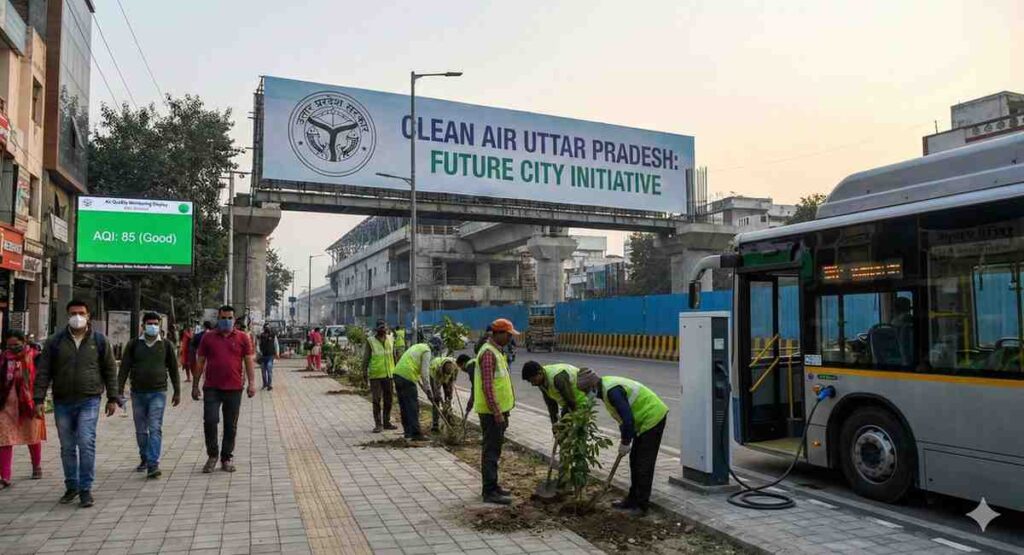
Implementing innovative strategies to combat air pollution and promote sustainable urban living. Introduction Uttar Pradesh, India’s most populous state, faces severe air quality challenges, particularly in its urban areas. With rising levels of particulate matter (PM2.5 and PM10) and other pollutants, addressing air quality concerns has become a priority for the state government. Through targeted
Implementing innovative strategies to combat air pollution and promote sustainable urban living.
Introduction
Uttar Pradesh, India’s most populous state, faces severe air quality challenges, particularly in its urban areas. With rising levels of particulate matter (PM2.5 and PM10) and other pollutants, addressing air quality concerns has become a priority for the state government. Through targeted policies, cutting-edge technology, and interdepartmental collaboration, Uttar Pradesh is striving to improve air quality and safeguard public health.
Strategic Initiatives to Improve Air Quality
1. State-Level Clean Air Action Plans
Uttar Pradesh has formulated city-specific and state-level clean air action plans to address localized sources of pollution. These plans focus on reducing emissions from transportation, industry, and construction, while also improving waste management practices.
- Key Focus Areas:
- Reduction of vehicular emissions through the promotion of electric vehicles (EVs) and public transportation.
- Introduction of clean fuel alternatives for industrial operations.
- Implementation of strict dust control measures at construction sites.
(Source: Central Pollution Control Board – CPCB)
2. Expansion of Air Quality Monitoring Networks
To better understand pollution patterns, the state is expanding its network of air quality monitoring stations across urban centers.
- Features:
- Deployment of additional Continuous Ambient Air Quality Monitoring Stations (CAAQMS).
- Real-time monitoring of key pollutants such as PM2.5, PM10, SO2, NO2, and CO.
- Integration of data into centralized dashboards for policy formulation.
(Source: Uttar Pradesh Pollution Control Board – UPPCB)
3. Implementation of Electric Vehicle (EV) Policy
The Uttar Pradesh Electric Vehicle Manufacturing and Mobility Policy 2022 aims to promote the adoption of EVs to curb vehicular emissions.
- Objectives:
- Achieve 25% EV penetration in urban public transport by 2030.
- Provide subsidies for EV purchases and charging infrastructure development.
- Replace diesel-run public buses with electric buses in major cities.
(Source: Government of Uttar Pradesh – EV Policy 2022)
4. Addressing Industrial Emissions
The state has mandated the adoption of cleaner technologies and fuels in industries to minimize emissions.
- Key Measures:
- Transition to PNG (Piped Natural Gas) in industrial clusters such as Kanpur and Agra.
- Installation of continuous emission monitoring systems (CEMS) in factories to ensure compliance.
(Source: Ministry of Environment, Forest, and Climate Change – MoEFCC)
Recent Achievements in Air Quality Improvement
- Swachh Vayu Survekshan (SVS) Recognition:
Several Uttar Pradesh cities, including Lucknow and Moradabad, have shown improvements in PM10 levels, earning accolades in the CPCB’s Swachh Vayu Survekshan rankings. - Reduction in PM2.5 Levels:
Kanpur and Agra recorded a noticeable decline in PM2.5 levels due to stricter enforcement of emission controls and vehicle regulations.
(Source: Central Pollution Control Board – Annual Report 2023)
Innovative Approaches for Sustainable Impact
1. Creation of Green Buffers
The state is actively promoting afforestation drives to create green buffers around urban areas, acting as natural air filters.
(Source: Uttar Pradesh Forest Department)
2. Adoption of Micro-Airshed Management
Localized emission control strategies are being implemented in specific “airsheds” to address pollution sources at the micro-level.
(Source: CPCB Guidance Manual)
Challenges Ahead
Despite significant progress, Uttar Pradesh faces several challenges:
- Rapid Urbanization: Increasing population density and urban sprawl contribute to heightened pollution levels.
- Seasonal Variations: Stubble burning in neighboring states exacerbates air quality issues during winter months.
- Behavioral Change: Encouraging citizens to adopt sustainable practices such as carpooling and waste segregation remains a challenge.
Conclusion
Uttar Pradesh’s comprehensive approach to tackling air quality challenges reflects its commitment to environmental sustainability and public health. By leveraging technology, enforcing regulations, and promoting cleaner alternatives, the state is making strides toward achieving cleaner air and healthier cities. With sustained efforts and community participation, Uttar Pradesh can serve as a model for air quality management in India.
Sources:
- Central Pollution Control Board – CPCB Reports
- Uttar Pradesh Pollution Control Board – Official Website
- Uttar Pradesh Electric Vehicle Policy 2022
- Ministry of Environment, Forest, and Climate Change – Annual Report 2023











Leave a Comment
Your email address will not be published. Required fields are marked with *