
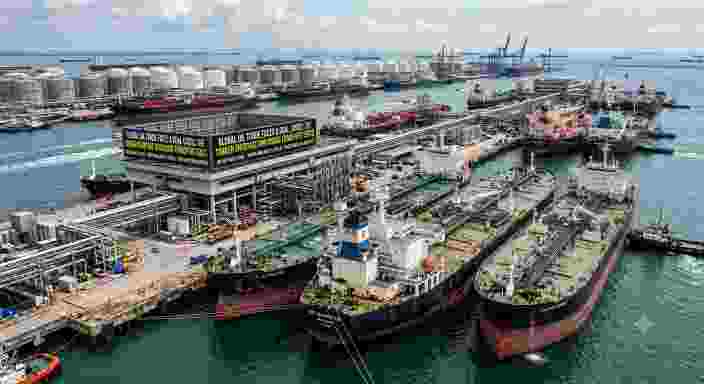
NEW DELHI/DUBAI — As ongoing geopolitical conflicts continue to roil energy markets, industry experts are warning that the next major bottleneck in the global oil supply chain may not be the crude itself, but the ships carrying it. A combination of regional warfare, pipeline outages, and a severe shortage of Very Large Crude Carriers (VLCCs)
NEW DELHI/DUBAI — As ongoing geopolitical conflicts continue to roil energy markets, industry experts are warning that the next major bottleneck in the global oil supply chain may not be the crude itself, but the ships carrying it. A combination of regional warfare, pipeline outages, and a severe shortage of Very Large Crude Carriers (VLCCs) is driving up global transport costs to unprecedented levels.
1. Chokepoints and Pipeline Disruptions
The crisis is rooted in widespread disruptions across key Middle Eastern energy corridors:
- The Strait of Hormuz: As a conflict involving Iran has intensified, flows through this vital Persian Gulf corridor—which normally supplies massive amounts of crude to Asia, Europe, and beyond—have been heavily disrupted.
- Saudi Arabia’s East-West Pipeline: Providing an alternate route to bypass Hormuz, the kingdom’s pipeline carrying crude to the Red Sea port of Yanbu was shut down following drone attacks.
- Red Sea Security Concerns: Amid security fears and Houthi-linked militant attacks, Saudi-flagged vessels have also suspended transits through the Bab al-Mandeb Strait. Consequently, ships are taking the lengthy detour around the Cape of Good Hope in South Africa, adding roughly two weeks to voyages.
2. The VLCC Crunch and Exploding Freight Costs
With pipelines offline and traditional routes blocked, a greater volume of crude is being pushed back onto oil tankers. However, the global fleet of roughly 900 Very Large Crude Carriers (VLCCs)—each capable of carrying around 2 million barrels—is severely strained.
- Tied-Up Fleet: Supertankers are increasingly tied up in short shuttle journeys around Hormuz or on prolonged detours around Africa, removing them from active circulation elsewhere.
- Skyrocketing Rates: Earlier this month, the cost of hiring a supertanker inside the Persian Gulf to travel through Hormuz crossed $1 million a day. According to maritime analytics firm Windward, this translates to roughly $26 a barrel in transport costs alone—accounting for about a quarter of the value of the crude itself at current prices.
- Additional Detour Costs: Rerouting more than a dozen Saudi-flagged vessels around the Cape of Good Hope adds an estimated $1 million in extra costs per trip per ship.
3. Impact on the Fuel Pump
Normally, freight is only a small fraction of an oil cargo’s total value. Now, soaring shipping costs are becoming a dominant part of the equation. Analysts warn that even if crude oil prices eventually stabilize or fall, refineries will continue paying high delivery costs—expenses that ultimately threaten to travel all the way down to the fuel pump.
Bottom Line
The global oil market is realizing that shipping capacity can be just as volatile as the commodity itself. With supertankers trapped by detours and exorbitant day rates pricing in the chaos, consumers may soon find that the true cost of energy isn’t just measured at the oil well, but in the miles it takes to get there.










Leave a Comment
Your email address will not be published. Required fields are marked with *