
New Delhi, July 2026 — The release of the latest UDISE+ and ASER education reports has exposed a massive structural paradox within India’s educational framework. While the country’s elite higher education institutions produce graduates pulling in multi-crore global salaries, the foundational primary school network is quietly suffering from a profound crisis of trust. The Apex
New Delhi, July 2026 — The release of the latest UDISE+ and ASER education reports has exposed a massive structural paradox within India’s educational framework. While the country’s elite higher education institutions produce graduates pulling in multi-crore global salaries, the foundational primary school network is quietly suffering from a profound crisis of trust.
The Apex Illusion
For decades, India has celebrated the triumphs of its premier tech campuses. Media headlines routinely spotlight IIT graduates landing annual packages ranging from ₹1.68 crore to ₹5.5 crore, fueled by an advanced infrastructure built on state-of-the-art AI labs and supercomputers.
However, data shows this elite ecosystem operates as a reverse pyramid. These top-tier institutions house a mere 3% of the nation’s higher education student pool but historically consume nearly 50% of the government’s central higher education funds, leaving the remaining 97% of students to squeeze into underfunded regional institutions.
The Great Primary School Exodus
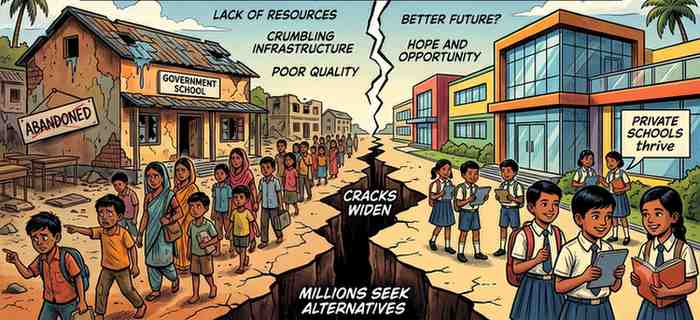
While the top of the pyramid is heavily funded, the public primary foundation is facing unprecedented abandonment. The UDISE+ report for 2025-26 highlights a staggering shift: over a two-year period, enrollment in government schools plummeted by nearly 86 lakh students. Over the exact same period, private unaided schools saw an influx of 88 lakh children.
This is not a voluntary migration toward luxury. Surveys indicate that an average family spends ₹2,863 annually on a child in a government school, compared to roughly ₹25,000 in a private school. Low-income parents are willingly paying a nine-fold premium not out of wealth, but because they have entirely lost hope in the state primary system.
A System Reduced to a Feeding Center
The drivers behind this mass exit are rooted in poor academic quality and systemic neglect:
- Severe Staffing Deficits: Nationwide, over 1 lakh primary schools are currently operating with only a single teacher tasked with handling all subjects across every grade level.
- The Literacy Gap: The ASER report reveals that 44.8% of Grade 5 students in government schools cannot read a basic Grade 2 textbook, and less than a third can solve a simple division problem.
- Prioritizing Plates Over Pages: While the Mid-Day Meal scheme remains a highly successful and necessary child nutrition program, schools have increasingly morphed into nutritional feeding hubs rather than centers of academic rigor.
The Historical Misstep
This crisis is the result of a deliberate policy choice. Post-independence, India adopted a “top-down” approach, focusing resources on creating world-class engineers in the hope that knowledge would trickle down.
In contrast, neighbors like China and Vietnam built from the ground up. China passed a compulsory education law in 1986—when it was economically poorer than India—making 9 years of school legally mandatory, penalizing businesses that hired underage dropouts, and tying local bureaucrats’ promotions directly to student attendance. India’s Right to Education (RTE) Act did not arrive until 2009, lagging 23 years behind.
Bottom Line
India’s education system has created two distinct worlds: one that secures ₹5.5 crore corporate packages, and another where a fifth grader cannot read a two-line paragraph. The 86 lakh children who walked away from government classrooms did not just change schools; they voted with their feet against a system that offers them a certificate, but deprives them of a digital future.










Leave a Comment
Your email address will not be published. Required fields are marked with *