
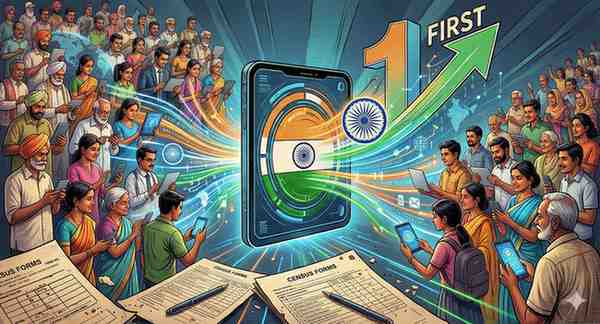
India’s Census 2027 will allow citizens to fill their enumeration forms online through a dedicated government portal, eliminating the need for enumerator home visits for those who opt in. This marks the first time in India’s 150-year census history that self-enumeration will be offered as a primary data collection method, potentially covering over 300 million
India’s Census 2027 will allow citizens to fill their enumeration forms online through a dedicated government portal, eliminating the need for enumerator home visits for those who opt in. This marks the first time in India’s 150-year census history that self-enumeration will be offered as a primary data collection method, potentially covering over 300 million digitally-active households.
New Delhi, April 2026 — The Registrar General of India has officially launched the self-enumeration module for Census 2027, enabling citizens to complete their household and individual census forms through a secure online platform without waiting for an enumerator’s visit.
Why Is India Shifting to Digital Census Collection?
The move addresses chronic challenges that have plagued previous census operations, including enumerator shortages, data entry errors, and the massive logistical burden of covering 1.4 billion people through door-to-door surveys. The COVID-19 pandemic, which delayed Census 2021 indefinitely, accelerated the government’s push toward contactless enumeration methods. Union Home Ministry officials estimate the digital option could reduce operational costs by up to 40 percent while improving data accuracy through real-time validation checks.
What Does Self-Enumeration Mean for Indian Households?
Citizens with Aadhaar-linked mobile numbers can access the portal, verify their identity through OTP authentication, and complete the census questionnaire in any of 18 scheduled languages. The process captures standard demographic data including age, gender, education, occupation, and housing conditions. Households that complete self-enumeration will receive a digital acknowledgment and will be excluded from the physical enumeration drive scheduled for late 2026. Rural areas with limited internet connectivity will continue to rely on traditional enumerator visits, though Common Service Centres have been authorised to assist willing participants.
Key Features of the Census 2027 Self-Enumeration System
- Aadhaar-based authentication ensures one submission per household with fraud prevention measures
- Forms available in 18 languages with voice-assisted navigation for accessibility
- Data encrypted end-to-end with servers housed within India under strict privacy protocols
- Deadline for self-enumeration set for September 2026, ahead of physical enumeration phase
- Dedicated helpline and video tutorials released by the Press Information Bureau
What Happens Next?
The Registrar General’s office expects approximately 25 percent of India’s 310 million households to use the digital option in this first implementation. Opposition parties have raised concerns about digital exclusion affecting marginalised communities, prompting assurances that traditional enumeration will remain fully operational. Census data, frozen since 2011, carries significant implications for delimitation of parliamentary constituencies, welfare scheme targeting, and federal resource allocation. The complete enumeration process is expected to conclude by March 2027, with provisional population figures likely by mid-2027.











Leave a Comment
Your email address will not be published. Required fields are marked with *