
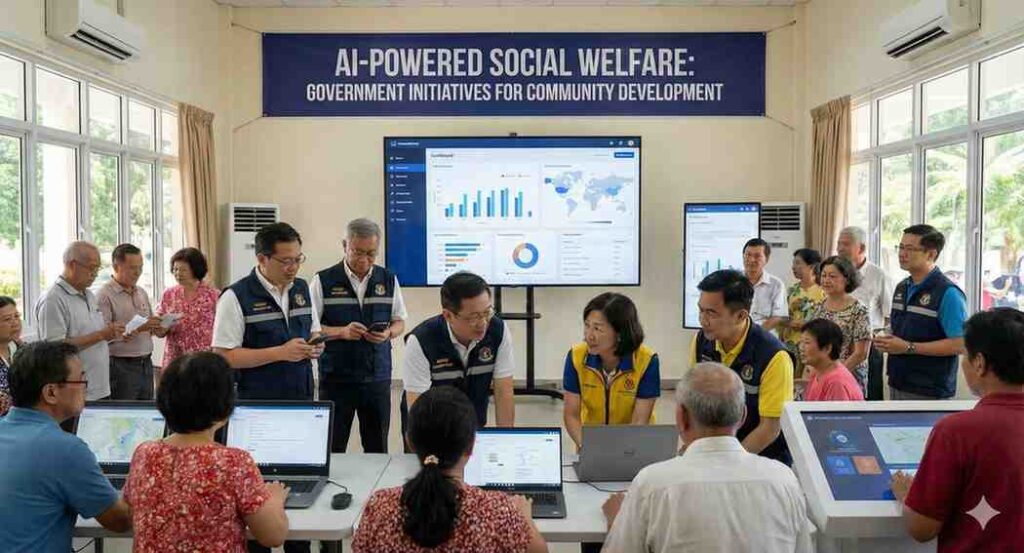
₹2,500 Crore Investment in AI for Social Welfare Programs Across India Key Highlights Real Government Initiatives in AI for Social Welfare The Indian government has been steadily increasing its focus on artificial intelligence (AI) to address critical social challenges and ensure that welfare services reach underserved communities. These efforts are primarily under initiatives such as the IndiaAI Mission and NITI
₹2,500 Crore Investment in AI for Social Welfare Programs Across India
Key Highlights
- Government allocates ₹2,500 crore under the IndiaAI Mission to integrate AI into social welfare programs.
- AI-driven initiatives to improve healthcare, education, poverty alleviation, and social security services.
- Special focus on AI solutions for underserved communities, rural areas, and marginalized groups.
- Collaborations with tech companies, NGOs, and academic institutions to ensure efficient implementation.
- Direct impact on millions of citizens through AI-powered services aimed at social empowerment.
Real Government Initiatives in AI for Social Welfare
The Indian government has been steadily increasing its focus on artificial intelligence (AI) to address critical social challenges and ensure that welfare services reach underserved communities. These efforts are primarily under initiatives such as the IndiaAI Mission and NITI Aayog’s National Strategy for AI, both of which emphasize the integration of AI into various sectors for public benefit.
AI in Healthcare
AI is already being integrated into healthcare as part of the government’s broader National Digital Health Mission (NDHM), which aims to improve access to healthcare services, particularly for underserved and rural populations. Under this mission, AI is being used to enable telemedicine, enhance diagnostics, and improve disease management:
- AI-based Diagnostic Tools: These tools have been developed to assist in early detection of diseases, such as cancer, diabetes, and cardiovascular conditions. AI-powered mobile health apps have been deployed in rural areas to increase the reach of healthcare services.
- Government-backed AI projects like E-Sanjeevani, a telemedicine platform, are leveraging AI for virtual consultations, helping millions in remote areas access medical expertise.
Official Source – National Health Authority
AI for Education and Skill Development
The Ministry of Education and Ministry of Skill Development and Entrepreneurship are focusing on AI-driven platforms for personalized learning and vocational training, specifically for youth in rural and economically disadvantaged areas:
- AI-Enabled Education Platforms: The government has launched platforms that leverage AI to provide personalized learning experiences to students, addressing gaps in the education system. AI is being used to create adaptive learning systems that cater to individual learning styles, improving educational outcomes.
- AI for Skill Development: The AI for India 2.0 initiative launched by the Ministry of Skill Developmentfocuses on upskilling millions in AI-related fields, particularly to enhance employability in both rural and urban areas.
Official Source – Ministry of Skill Development and Entrepreneurship
AI in Poverty Alleviation and Social Security
The Indian government has adopted AI to optimize welfare distribution and improve the identification of vulnerable populations. AI systems are used to enhance the delivery of social security benefits like pensions, subsidies, and food distribution, ensuring that the benefits reach the right people without leakage:
- AI-Based Poverty Identification: The government uses AI tools to analyze large datasets and identify households that are eligible for welfare programs, improving targeting efficiency. For example, AI is helping to streamline the Public Distribution System (PDS), ensuring food and subsidies are accurately distributed to low-income families.
- Social Security Programs: AI is being implemented in the Pradhan Mantri Jan Dhan Yojana and Pradhan Mantri Kisan Samman Nidhi to identify beneficiaries more accurately and ensure transparency.
Official Source – Ministry of Rural Development
AI for Rural and Marginalized Communities
AI solutions are being integrated into rural development programs to improve resource management, agriculture, and livelihood generation:
- AI in Agriculture: Through the National Agriculture Market (eNAM) and AI-driven crop monitoring systems, AI is being used to provide farmers with real-time data on soil health, weather forecasts, and crop health, improving productivity and reducing the risks associated with farming.
- AI for Employment: In rural areas, AI platforms are helping connect workers with job opportunities, particularly in sectors like construction, handicrafts, and agriculture, where access to opportunities has traditionally been limited.
Official Source – Ministry of Agriculture and Farmers Welfare
Data-Driven Social Welfare Systems
The Indian government is investing in AI-powered data analytics to improve the efficiency of welfare distribution systems. AI is being used to ensure that funds reach the intended beneficiaries and that services are tailored to the needs of diverse communities:
- AI-Powered Decision Support Systems: These systems use machine learning algorithms to analyze data from various government welfare schemes, helping decision-makers identify bottlenecks and optimize resource allocation.
Challenges and Solutions
While AI presents numerous opportunities for improving social welfare, there are several challenges that need to be addressed:
- Data Privacy and Security: As AI systems collect and process vast amounts of personal data, there is a need for stringent data protection measures to ensure privacy.
- The government has introduced the Personal Data Protection Bill, which aims to safeguard individuals’ privacy while enabling the use of AI for social good.
- Infrastructure Gaps in Rural Areas: Many rural areas still lack the digital infrastructure needed to deploy AI-driven services effectively.
- The government is addressing this through initiatives like Digital India, which aims to expand internet access and improve connectivity across the country.
- Digital Literacy: There is a need for increased digital literacy in rural and underserved regions to ensure citizens can fully benefit from AI-driven services.
- The government is promoting AI literacy and training programs to build skills, particularly in rural areas.
Conclusion
The Indian government’s efforts to harness AI for social welfare are rooted in several real, ongoing projects and initiatives aimed at transforming the lives of citizens, especially those in rural and marginalized communities. By integrating AI into healthcare, education, poverty alleviation, and social security systems, these programs ensure that AI delivers tangible benefits to the country’s most vulnerable populations.
With substantial investments, government-backed initiatives, and collaborations with global tech firms, India is setting the stage to become a leader in AI for social good, enhancing the lives of millions through more effective and inclusive public services.












Leave a Comment
Your email address will not be published. Required fields are marked with *