




London, February 20, 2026 — In a historic departure from decades of transatlantic military coordination, UK Prime Minister Keir Starmer has officially denied President Donald Trump permission to use British sovereign bases for potential strikes against Iran. The decision marks the most significant friction point in the UK-US “Special Relationship” since the Suez Crisis. Strategic
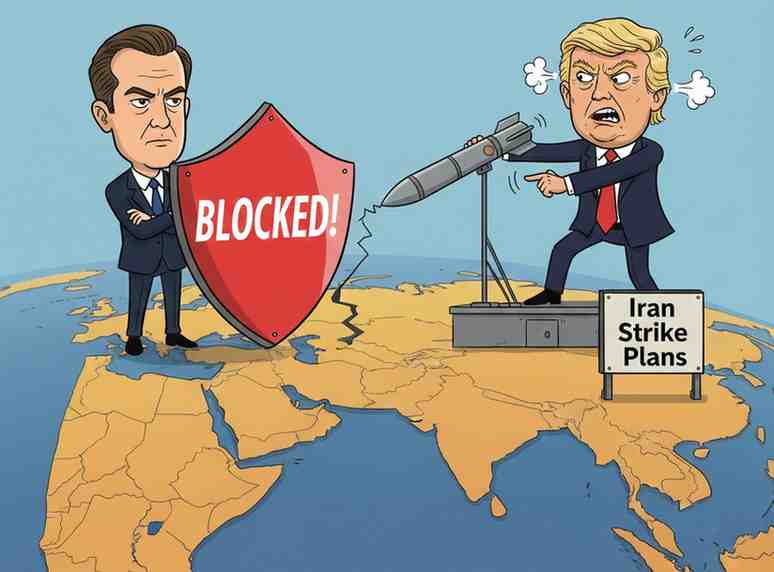
London, February 20, 2026 — In a historic departure from decades of transatlantic military coordination, UK Prime Minister Keir Starmer has officially denied President Donald Trump permission to use British sovereign bases for potential strikes against Iran. The decision marks the most significant friction point in the UK-US “Special Relationship” since the Suez Crisis.
Strategic Bases at the Center of the Storm
The Pentagon had requested the use of two critical British-controlled facilities to facilitate its regional operations:
- RAF Fairford (Gloucestershire, England): Historically the only forward operating location in Europe for US heavy bombers like the B-52 and B-1.
- Diego Garcia (Indian Ocean): A vital launchpad for Indian Ocean and Middle Eastern operations, hosting long-range bombers and naval supply vessels.
While these bases frequently host American assets, the UK-US Defense Agreement mandates that any “offensive use” requires the explicit consent of the British Prime Minister—a consent that has now been withheld.
The Legal and Diplomatic “No”
The Starmer administration’s refusal is rooted in a fundamental disagreement over international law. British legal advisors have reportedly warned that supporting a preemptive strike without a specific UN Security Council mandate could expose the UK to international litigation and domestic legal challenges.
Beyond the law, the move signals the UK’s shift toward a more independent foreign policy. Unlike previous administrations that largely mirrored Washington’s “maximum pressure” tactics, London is now prioritizing regional de-escalation over military involvement.
Trump’s 10-Day Ultimatum
The denial comes as the White House enters a high-stakes standoff with Tehran. Accusing Iran of accelerating its uranium enrichment and ignoring red lines, President Trump recently declared a 10-day window for Iran to comply with US demands or face military intervention.
The US has already mobilized massive firepower in the region:
- The USS Abraham Lincoln and the highly advanced USS Gerald R. Ford carrier strike groups are now stationed in the Arabian Sea.
- Over 50 advanced fighter jets, including F-22 Raptors and F-35s, have been moved to regional hubs like Qatar.
The Fallout: A Strained Alliance
Washington has expressed “disappointment” at the UK’s stance, with some US officials warning of a breakdown in intelligence-sharing or a rethink of the Chagos Islands sovereignty negotiations. For the UK, however, the risk of being pulled into a multi-front Middle Eastern war outweighs the diplomatic discomfort.
The move has created a strategic hurdle for US planners. Without RAF Fairford or Diego Garcia, the US must rely more heavily on Middle Eastern allies (like Qatar or the UAE), some of whom are also hesitant to host offensive operations for fear of Iranian retaliation.
Bottom Line
The era of unconditional British support for US military ventures is over. By blocking the use of RAF bases, Keir Starmer has drawn a line in the sand: the UK will no longer act as a silent partner in unilateral strikes. For Donald Trump, the “Special Relationship” has just become significantly more complicated.



















Leave a Comment
Your email address will not be published. Required fields are marked with *