





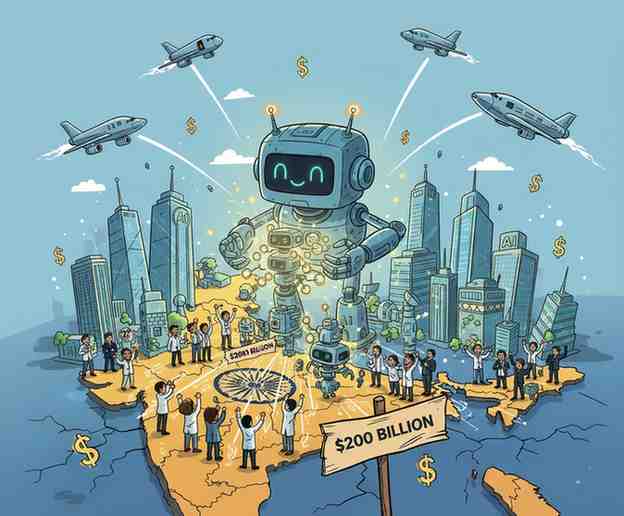
NEW DELHI — Union Minister Ashwini Vaishnaw has announced a bold roadmap for India’s digital future, projecting over $200 billion in AI-related investments over the next two years. Speaking at the India AI Impact Summit 2026 at Bharat Mandapam, the Minister declared that India is transitioning from a consumer of technology to a global hub
NEW DELHI — Union Minister Ashwini Vaishnaw has announced a bold roadmap for India’s digital future, projecting over $200 billion in AI-related investments over the next two years. Speaking at the India AI Impact Summit 2026 at Bharat Mandapam, the Minister declared that India is transitioning from a consumer of technology to a global hub for affordable, high-impact artificial intelligence.
The announcement comes as the government ramps up its “IndiaAI Mission,” seeking to democratize access to cutting-edge technology for startups, researchers, and the common citizen.
The $200 Billion Ambition
The Minister outlined a massive investment pipeline targeting all five layers of the AI stack—from physical infrastructure and compute power to foundational models and applications.
- Current Momentum: Approximately $17 billion has already been committed by Venture Capitalists (VCs) toward Indian deep-tech and AI startups.
- Infrastructure Surge: A significant portion of the $200 billion is earmarked for data centers and energy infrastructure.
- Compute Power: To support this growth, Vaishnaw confirmed orders for 20,000 additional GPUs will be placed within a week, adding to the existing 38,000 units already available to Indian innovators at subsidized rates.
“India’s unique advantage lies in developing solutions at a population scale. We are creating a model that challenges the expensive Western versions, particularly in healthcare and agriculture,” Vaishnaw stated.
A “UPI-Equivalent” for AI
In a move to mirror the success of India’s digital payments revolution, the Minister proposed an “AI-UPI” model. This framework will provide a bouquet of trusted, security-tested AI solutions for MSMEs, farmers, and healthcare workers, delivered in local languages to ensure last-mile accessibility.
Navigating the Talent Transition
Addressing “Gen Z” concerns regarding automation and job displacement, the government is prioritizing a Three-Way Collaboration between the state, industry, and academia.
- Curriculum Overhaul: National education frameworks are being updated to include AI-ready skills.
- Reskilling Pillars: Massive upskilling programs are being integrated into the national AI mission to transition the current workforce into the “Intelligence Age.”
Combating Deepfakes and Protecting Trust
As AI becomes more integrated into daily life, the government is taking a strict “Techno-Legal” approach to safety.
- Watermarking: Regulations now require AI-generated synthetic content to be clearly watermarked to distinguish “fake content” from reality.
- Copyright Protection: The Minister emphasized the need for a global consensus to ensure creators receive fair remuneration when their work is used to train AI models.
Public Interest Hits Record High
Despite early logistical hurdles at the venue, the summit saw a staggering turnout of over 100,000 visitors in a single day. A dedicated “War Room” was established by the ministry to manage the surge, which Vaishnaw described as a sign of the “immense energy and curiosity” among India’s youth and entrepreneurs.
Bottom Line: With a focus on affordability and ethical guardrails, India is positioning itself as the primary “infra layer” for the global AI ecosystem, signaling to global giants that the nation is now the most important frontier of the fifth industrial revolution.


















Leave a Comment
Your email address will not be published. Required fields are marked with *